
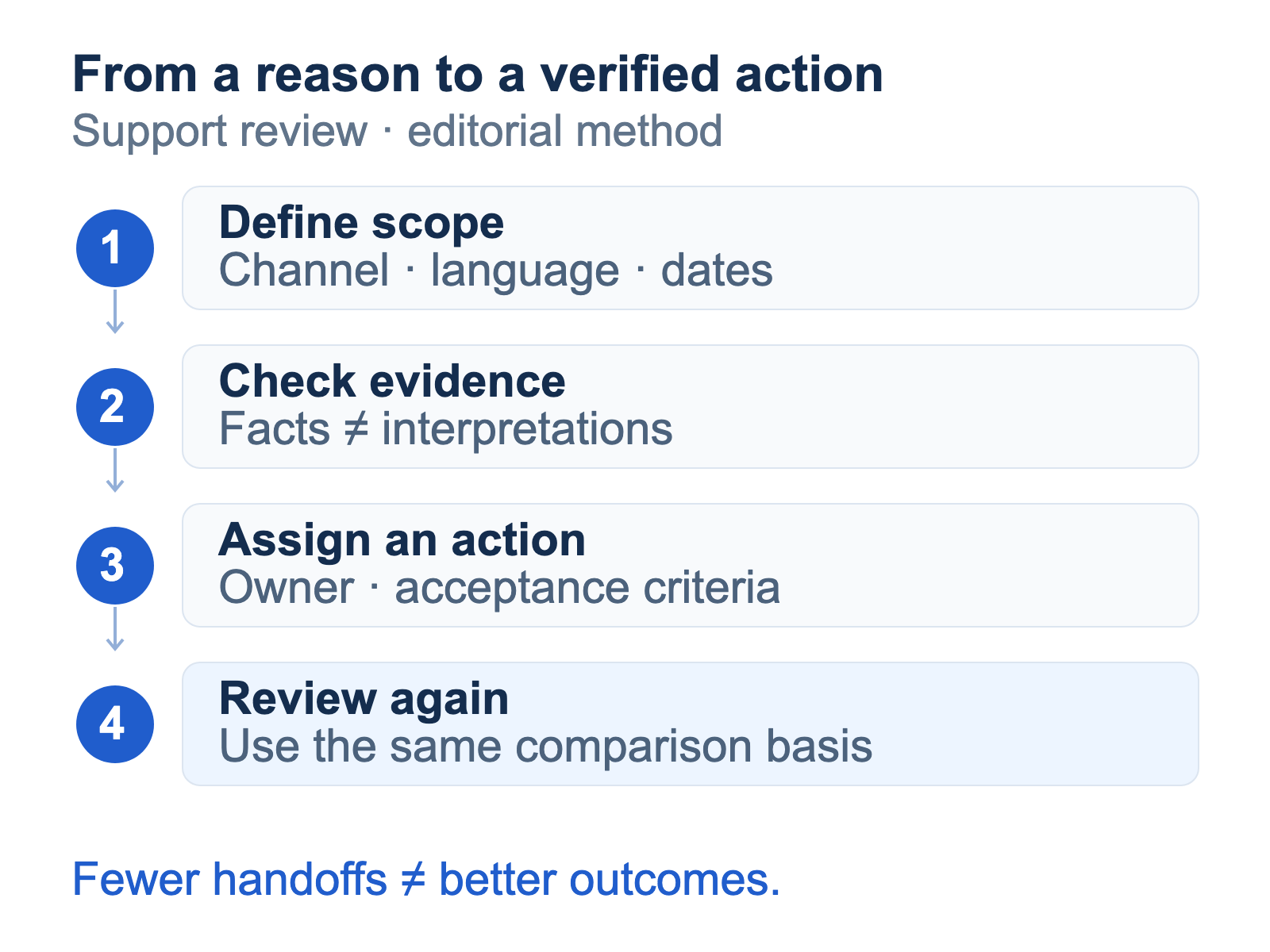
To review why support conversations are handed to a human, define a consistent scope, check the conversation evidence, separate the causes, assign specific actions, and review the results on the same basis. Missing information, decisions that require a person, and handoff-process problems need different responses. Yuna can help summarize handoff reasons within the data a member is allowed to view. The team should still check important conclusions against the original conversations. The aim is not to eliminate every handoff: it is to reduce avoidable repetition while preserving necessary human judgment.
A cross-border support report might say “shipping questions were common” week after week. The problem is not necessarily a shortage of statistics. That sentence does not identify what to change. Did shoppers ask about delivery estimates or a tracking page that had stopped updating? Did an agent explain an existing policy or contact a carrier to investigate an exception? One FAQ cannot address all of those situations.
This guide provides a practical review method and a suggested request for Yuna. The categories, worksheet and examples are editorial recommendations or hypothetical illustrations, not fixed product report fields or customer performance results.
Step 1: define the scope before asking what went wrong
You need permission to view the relevant conversations, records you can check, and a colleague authorized to confirm business rules. Write down the start and end dates, reporting time zone, channel, customer language and inclusion criteria. For example, review last week’s English-language after-sales website conversations that involved a human handoff. Keep this week’s sales inquiries and other channels outside that scope. A cross-border team should explicitly choose the time zone that defines each day.
Agree on the counting unit as well. A conversation can cover shipping and refunds, or move between two agents after the initial handoff. Keep conversation counts separate from transfer-event counts. For a distribution of topics, give each conversation a primary reason and retain other reasons as secondary labels. For repeated transfers, examine events separately. Adding up overlapping labels does not produce a count of unique conversations.
If a full review is impractical, start with a manageable sample and record how it was selected. The most severe complaints can help investigate risk, but they do not necessarily represent the whole workload. Check common inquiries, complex exceptions and cases with unclear reasons separately. When coverage is incomplete, write “in the sample reviewed,” not “what all customers care about most.”
Step 2: ask Yuna to organize reasons and preserve unknowns
The Yuna common-tasks documentation describes summarizing handoff reasons for a specified period, using data the current member may view. Yuna is the team-facing assistant in YundaDesk AI customer service. Use its summary as a starting point, then check important records. The request below is a suggested format, not a guarantee that every workspace exposes the same data, permissions or output fields.
Review human handoffs for [start/end dates and time zone], limited to [channel and language]. Use only data I am allowed to view. Do not change settings or send messages. First state the actual coverage, missing information and counting unit. Group the conversations by primary reason and, where available, provide conversation references or evidence that I can check. Separate recorded facts, interpretations and unknowns. Do not invent a reason when the evidence is insufficient.
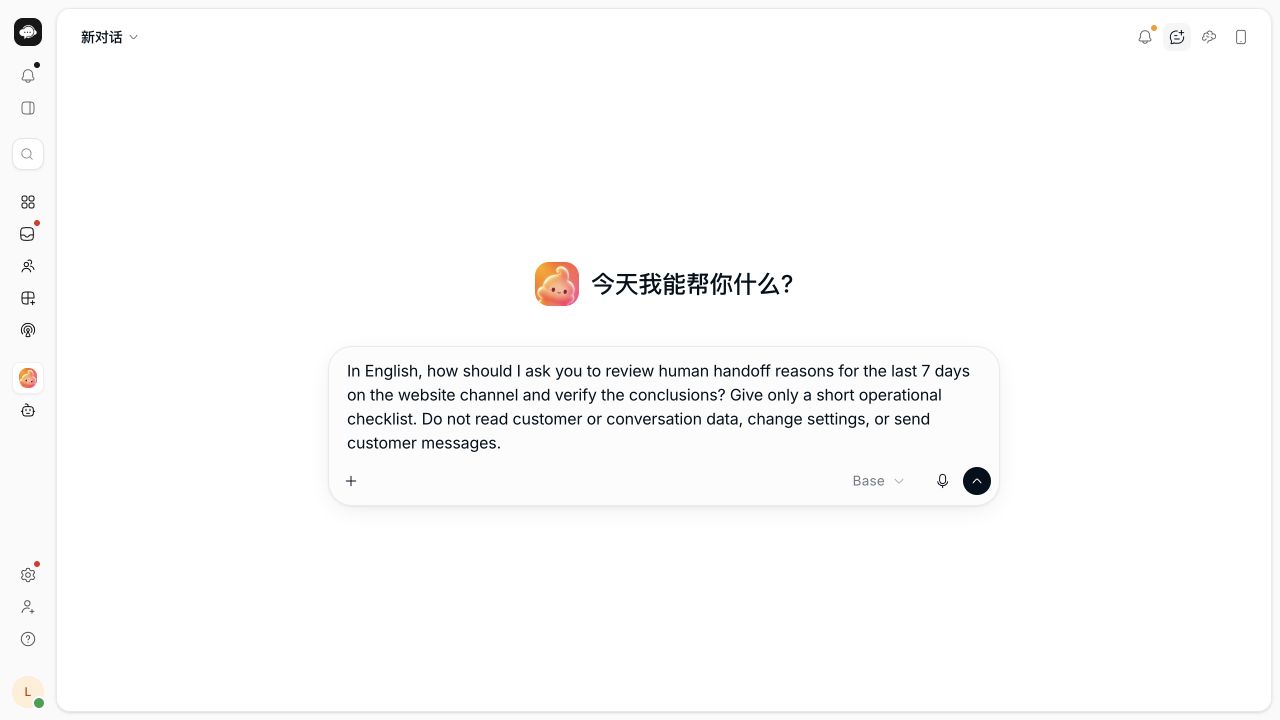
Check the scope before accepting the conclusions. A plausible category name is not proof that a conversation supports it. If the result is only an aggregate summary, narrow the request or open the relevant records yourself before using it in a formal report. Where access is missing, ask an authorized colleague to verify the records rather than routing customer information through an uncontrolled tool.
For each important case, examine what the customer initially wanted, the last meaningful answer before the handoff, what the human actually added or decided, and what remained unresolved. “I want a person” can be a direct trigger without explaining the underlying cause. An agent discovering outdated guidance provides a further clue. Conversely, a request to “help with a refund” is not evidence that the customer was angry or that the AI made an error.
Step 3: choose an action by cause, not by keyword
The following categories are a discussion framework, not built-in product labels. Adapt their names if needed, but connect each one to observable evidence and a distinct response.
- Missing or unclear information: an agent supplies a repeatable explanation based on an approved rule, while existing material is incomplete, outdated or unclear about conditions. Ask the business owner to confirm the rule before adding the question, conditions and exceptions.
- A decision or action requiring a person: the request involves an exception, an order investigation or a compensation decision. Improve information collection, next-step explanations and ownership. Do not expect an FAQ to make the decision.
- A reception or collaboration problem: information exists, but ownership after transfer is unclear, the customer repeats information, or message and handoff states need checking. Examine the process and actual state rather than adding answer entries to mask the issue.
- Insufficient evidence: context is missing, the customer stopped replying, or the sequence cannot be confirmed. Keep the cause unknown and arrange a check. Do not force it into an “AI misunderstanding” category just to complete a chart.
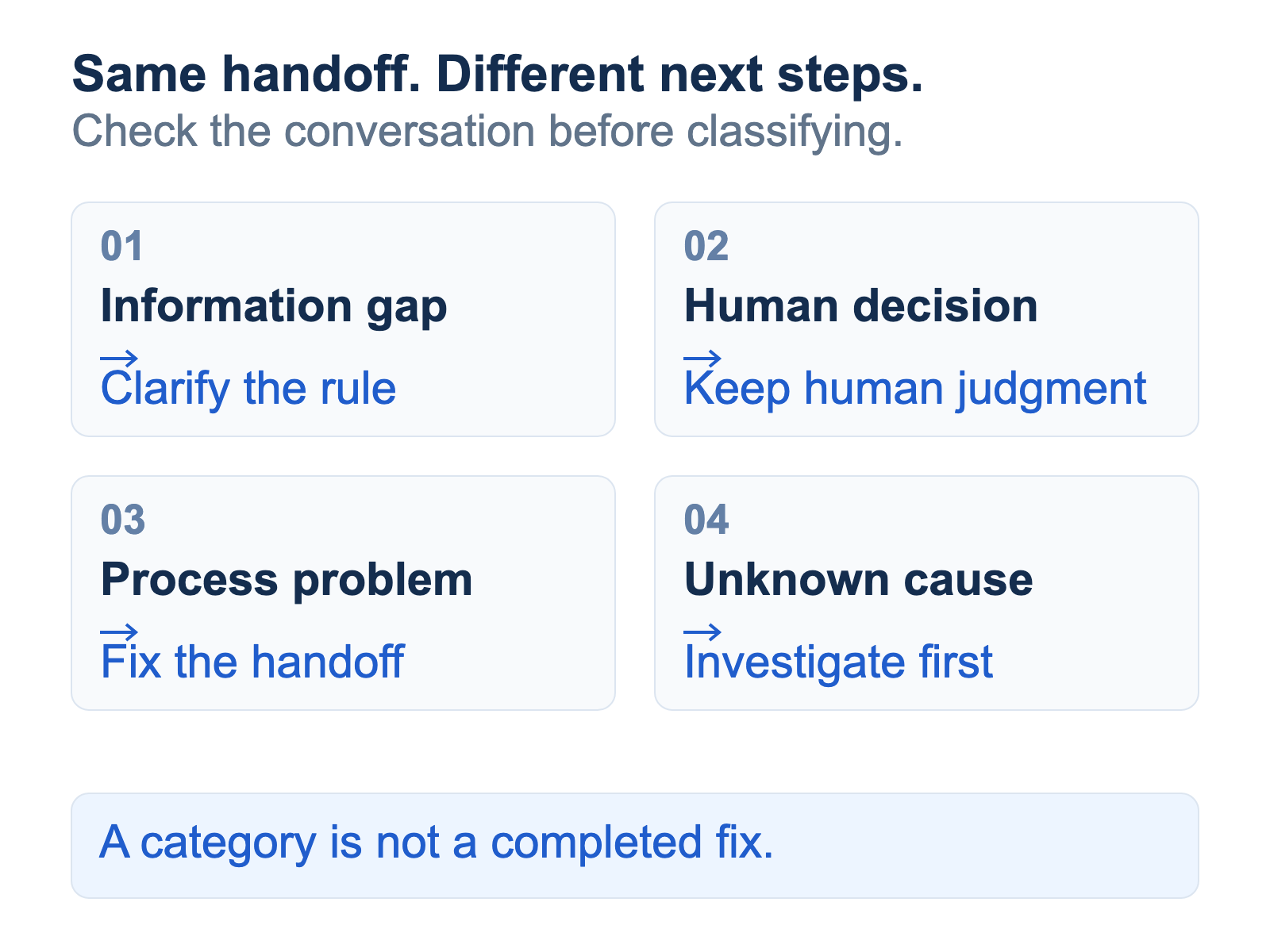
Consider the hypothetical question “Why hasn’t my package arrived?” If the agent only explains the confirmed tracking-update policy, clearer guidance may help. If the order needs investigation, someone first needs reliable order information. If the customer asks for an exceptional compensation arrangement, an authorized person must decide. All three contain the word “shipping,” but they should not become one generic knowledge-base task.
Step 4: turn a finding into an owned action
For each action, record six things: the observed problem, its evidence location, the cause to verify, the proposed change, an owner and due date, and an acceptance condition. Keep evidence references in an access-controlled internal record. When sharing across teams, provide only the necessary redacted summary rather than complete customer details. Yuna can help organize the findings, but the team maintains this worksheet; do not assume a summary automatically creates product tasks.
A useful action might read: “In the reviewed sample, customers repeatedly asked what an unchanged tracking page means. The logistics owner will check the current explanation and document applicable conditions and cases requiring investigation. The support lead will test the original question and alternate wording, and confirm that orders requiring investigation still go to a person.” This is more actionable than “improve shipping FAQs” and does not promise a particular performance gain.
Frequency alone should not set priority. An uncommon issue that could create an incorrect commitment may deserve attention before a frequent wording problem. Consider impact, evidence strength, ownership and effort when choosing what to address in this review cycle. Changing a few related variables also makes subsequent observations easier to interpret.
Where a finding genuinely belongs in answer material, gather the original question, approved business basis and applicable scope before asking Yuna to prepare a suggestion for review. The official common-tasks guide distinguishes teaching requests from a universal change to customer answers. “Suggestion prepared” should therefore not become “all customers now receive the new answer.” Keep bulk reception-setting changes outside the review request.
Step 5: verify the result, not only the handoff rate
After a change, run targeted tests before examining comparable later records. For guidance changes, test the original question, a rephrased version and a counterexample that does not satisfy the policy conditions. Check whether the answer follows the current rule, explains its conditions and still routes cases requiring judgment to a person. Passing those cases establishes that those tests passed; it does not replace later checks of real support conversations.
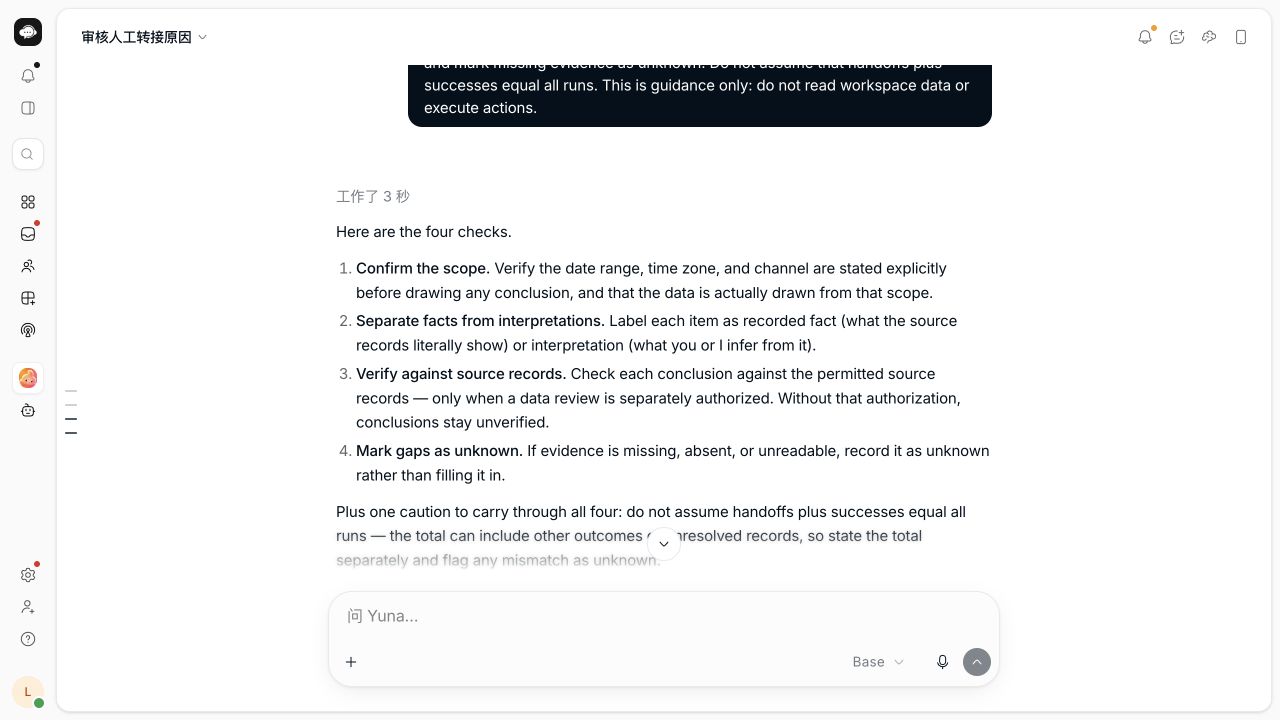
Keep the channel, language, time boundaries and sampling method consistent where possible. Record changes such as promotions, holidays, order mix or staffing. A lower handoff count is not an improvement by itself if unresolved complaints or repeated inquiries increase. Conversely, more appropriate handoffs may reflect better recognition of exceptions. Correct handling matters more than pursuing an isolated lower number.
If the sample is too small to support a conclusion, say so. You can first verify that the policy revision, tests and ownership changes are complete, then wait for more conversation evidence. A simple before-and-after comparison does not establish causation. A closed-conversation state is not, by itself, proof that the customer’s issue was resolved.
Common questions and troubleshooting
What if Yuna’s categories look reasonable but I cannot find the supporting conversations?
Check the requested scope and permissions. Ask for traceable references or an explicit statement of which conclusions lack evidence. If you still cannot verify a claim, mark it for investigation and inspect the records manually rather than copying an interpretation as fact.
How should I count a conversation with several reasons?
For topic distribution, use a primary reason plus secondary labels and document the primary-reason rule. Count transfer events separately. Consistent definitions and a clear denominator matter more than forcing every record into a single label.
Should a repeated question immediately change AI answers?
First determine whether it is an information problem or a business-action problem. Move into the appropriate revision and review process only when the business basis, scope and test conditions are clear. Investigate incomplete evidence first; one customer’s request is not a general policy.
How often should we review handoffs?
A weekly discussion can be a starting point, adjusted for volume and risk. Review specific issues after a rule change or clear anomaly. This is a suggested team cadence, not a default automation, and it is not a reason to overinterpret a small sample.
Start with one clearly bounded question
You do not need a complete analytics program for the first review. Choose one channel and period, ask Yuna to help organize the reasons, verify the important conversations, and produce an action list with evidence, owners and acceptance conditions. A review becomes operational when the team knows who will act and how the result will be checked.
For orientation, read the Yuna introduction for support teams. For the related question of preserving context when a person takes over, see our handoff-context and shift-transfer guide (Chinese). That guide focuses on the transfer itself; this article focuses on reviewing its causes.
By the YundaDesk team. This is first-party product guidance and an editorial support-operations method. Product documentation checked on September 16, 2026. Examples are not real customer records.